

Exciting developments in the world of data protection: OpenAI has released a privacy filter as open source for developers.
This is a positive signal for the AI privacy ecosystem. Data protection is being taken seriously, showing that international players seem to be aware of the need to protect sensitive data when using AI. But how far does this signal actually reach, and what does it mean in practice for companies in Germany, Austria and Switzerland?
The OpenAI filter is an important sign of technical openness and a building block within comprehensive solutions. For complete data protection, legally compliant AI processes and productive use in companies, however, holistic, European-hosted, sovereign platforms like NENNA are required.
Why a privacy filter is only the beginning
Personally identifiable information (PII) is detected and removed from texts with a high success rate. The model demonstrates how seriously international tech corporations now take the protection of private data. Yet, for corporate reality and European compliance, the actual work is only just beginning. This is because the tool is clearly designed as a developer component, not as a ready-to-use solution for business departments or end users.
This means that anyone wishing to use the privacy filter needs machine learning capabilities, time for fine-tuning and integration expertise. The model covers eight data categories. For a typical AI rollout in an enterprise (from HR to Legal, from administration to medium-sized businesses), this is not always practical.
Why NENNA.AI takes a different approach and why this is crucial for European companies
Since its foundation in 2023, NENNA.AI has pursued the aspiration of not viewing AI as an either-or question: productivity and data protection belong together. In doing so, we respond to the central challenge of many organisations: shadow use of AI, lack of control over data flows and the complex requirements of the GDPR and the EU AI Act.
The AI privacy platform from NENNA gives companies in the DACH region full control over their AI usage, with ready-to-use modules, high technical sovereignty and verified compliance.
How real data protection innovation succeeds
The security and sovereignty of our users are the top priority at NENNA.AI. For this reason, the platform is operated exclusively in data centres in Germany (Frankfurt am Main), on European cloud infrastructure from Exoscale. This meets ISO 27001 and BSI C5 standards. For maximum protection and legal certainty, no data is transferred to third countries. On-premise and hybrid operations are optionally available. Flexibility and compliance are therefore guaranteed.
Legal requirements and technical sovereignty: solved holistically
With NENNA.AI, full GDPR compliance is integrated into every function from the very beginning. Personal data is technically anonymised or masked even before processing, so that it can never flow into the AI models – even unintentionally through shadow use or external tools.
Companies can define at model level which data categories may be processed, which models are active and according to which rules data can be masked and individually adapted. This also rules out the inclusion of special categories under Art. 9 GDPR in advance.
Typical real-world use cases
Protection of sensitive information in law firms and consultancies (BRAO-compliant)
GDPR-compliant AI integration in the financial and banking sector
Control and monitoring of shadow IT in medium-sized enterprises
Administration: support with citizen enquiries, document assistance, knowledge management, without the risk of data leaks
Enterprise-ready in three months
NENNA.AI is productively in use at large corporations in legal, finance and industry, all the way to technologically driven medium-sized businesses. NENNA takes care of the technical deployment of the platform, use case onboarding, governance definition and a comprehensive employee training programme. This guarantees productive, auditable and secure AI use.
Tabular direct comparison: Privacy Filter vs NENNA Platform
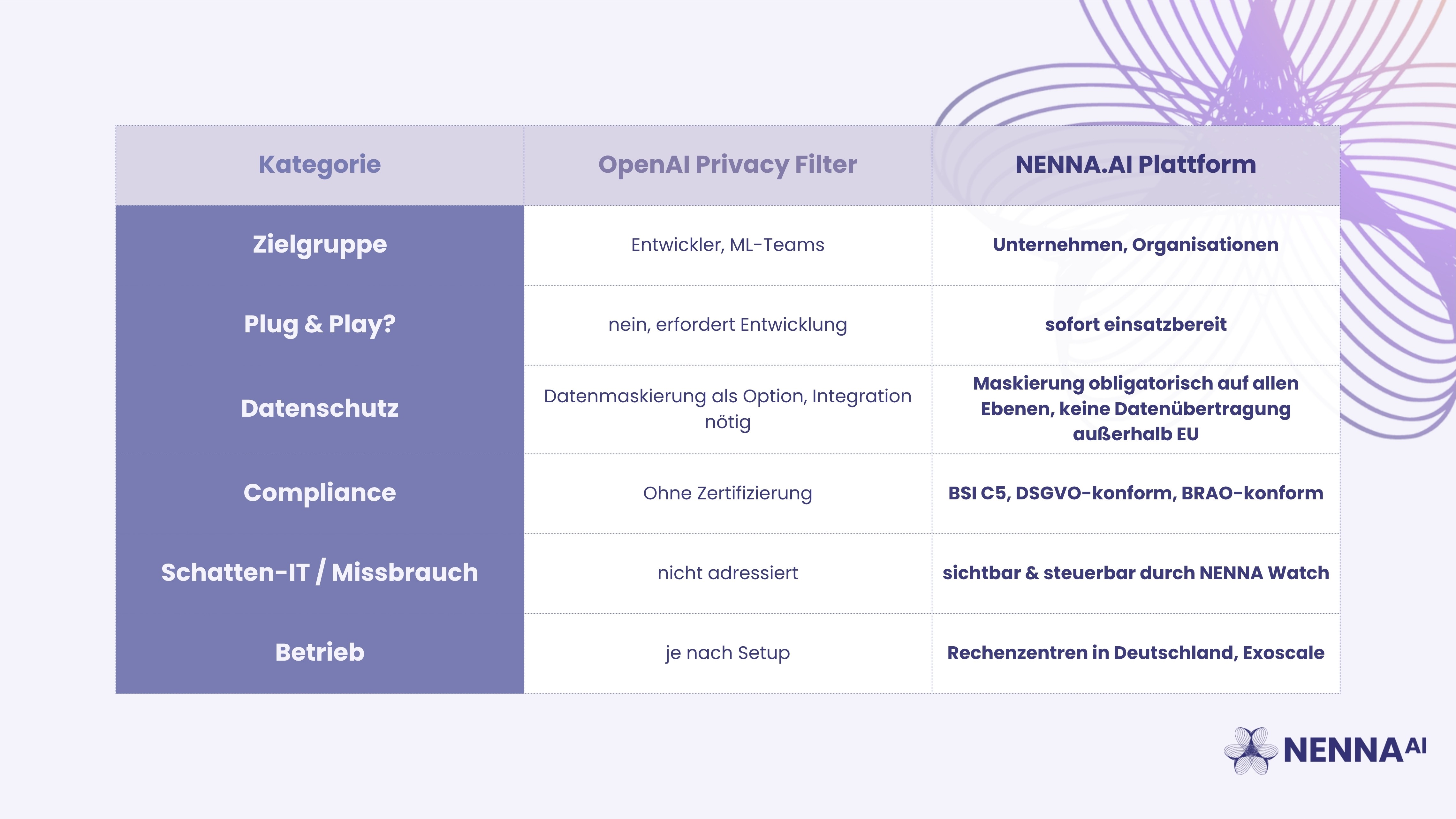
AI-powered data protection needs a central platform, not an isolated solution
True AI privacy only arises when data security is not optional, but the default standard.
Therefore: No leaks, no drama. Made in Germany.
Read more
All items


