Knowledge
NENNA.AI named one of the best cybersecurity startups in the DACH region
NENNA has been awarded third place in the prestigious ATHENE Digital Hub Cybersecurity Startup Award at Europe’s largest cybersecurity expo, it-sa, Home of IT Security. This accolade positions NENNA.AI as one of the three leading cybersecurity startups in the German-speaking (DACH) region.

Kassandra Buettner
VP of Growth & Marketing
·
·
4 mins reading time

What is NENNA.AI?
Generative Artificial Intelligence (AI) has the potential to bring about a massive leap in the efficiency of existing work processes across countless areas. The use of AI models is establishing itself as an optimization tool in many companies. AI applications promise efficiency gains, but since the introduction of the EU AI Act at the latest, many firms have realized that the technology also brings risks.
Precautions must be taken if we want to work with the tool responsibly. This applies from a social and societal perspective as well as in relation to data protection.
This is exactly where NENNA.AI comes in. Our mission is to enable companies to use AI tools securely and in compliance with data regulations. Our AI enablement solution masks personal data directly during prompting. This gives users the opportunity to check their inputs and protect personal data in a GDPR compliant way. At the same time, NENNA.AI allows the generated text to be copied and unmasked from the application so that it remains usable for its intended purpose. NENNA.AI is a SaaS solution and can be used directly in the browser and with over 300 applications.
Why must personal data be masked when entering it into Large Language Models (LLMs) like ChatGPT?
A corresponding market study on Generative AI conducted in the third quarter of 2024 revealed that 30% of companies using AI had already recorded security incidents. In another study conducted by Gartner, industry professionals cited generative AI as one of the biggest current risks to IT and policy. ChatGPT users have also expressed concerns about data leaks with OpenAI's AI powered chatbot. During these incidents, sensitive data such as personal information, chat histories and login credentials were exposed.
The majority of successful cyberattacks on companies are not made possible by the technology itself, but are attributed to the misconduct of employees. This was reported by the Handelsblatt Journal in its 2024 edition on Cybersecurity & Data Protection.
Employees often independently use generative AI tools like chatbots or text generators to make their work easier. A recent Bitkom survey shows that in 34% of German companies employees use generative applications like ChatGPT via private accounts, even when no internal company solutions are available.
It is about building a strong "cybersecurity culture", and to this end, measures must be taken to train employees accordingly, which the EU AI Act has required since February. Cybersecurity issues must be identified and clearly communicated. Appropriate technical tools can assist employees in implementing various precautionary measures alongside organizational policies. NENNA.AI offers a framework with which companies can implement measures in accordance with the EU AI Act and GDPR.
Why an enablement platform like NENNA.AI makes all the difference for AI use in companies
With NENNA, working with AI models while maintaining data protection becomes possible. That is AI Enablement. Under the General Data Protection Regulation (GDPR), companies are not allowed to enter personal data into AI models like ChatGPT because this data can be passed on. Particularly with the launch of DeepSeek, the topic of data protection has come into sharp focus. Some countries, including Italy, the US and Taiwan, have banned the use of the model in certain areas such as government agencies because the privacy aspects are too risky. This must not happen without the consent of the individuals concerned.
Let us stick to the example of ChatGPT: the problem is that entered data is stored and used to train the model. Companies should therefore proactively implement protection mechanisms for AI solutions and establish clear guidelines for their use in order to address security concerns and effectively harness the benefits of AI technologies.
With NENNA.AI, data-protected content is not entered into LLMs in the first place because it is masked beforehand. If companies tackle this right at the input stage, losses of private data can be prevented. This eliminates the worry of data leaking uncontrollably or AI tools becoming a company risk.
Protection against data leaks & shadow IT: Secure AI use without compliance risks
The software protects data directly on the employee's computer, meaning this information never leaves the device. As a result, intellectual property remains protected, and valuable information is not used by AI providers to train their models. In addition, NENNA.AI puts an end to the risks of shadow IT, which refers to the use of LLMs without the company's permission.
The uploading of confidential documents can hardly be controlled. This not only leads to potential GDPR violations but can also result in a malicious or unintentional breach of contractual or statutory confidentiality obligations. In such cases, employees and, under certain circumstances, their employers could face claims for damages, contractual penalties or labor law consequences.
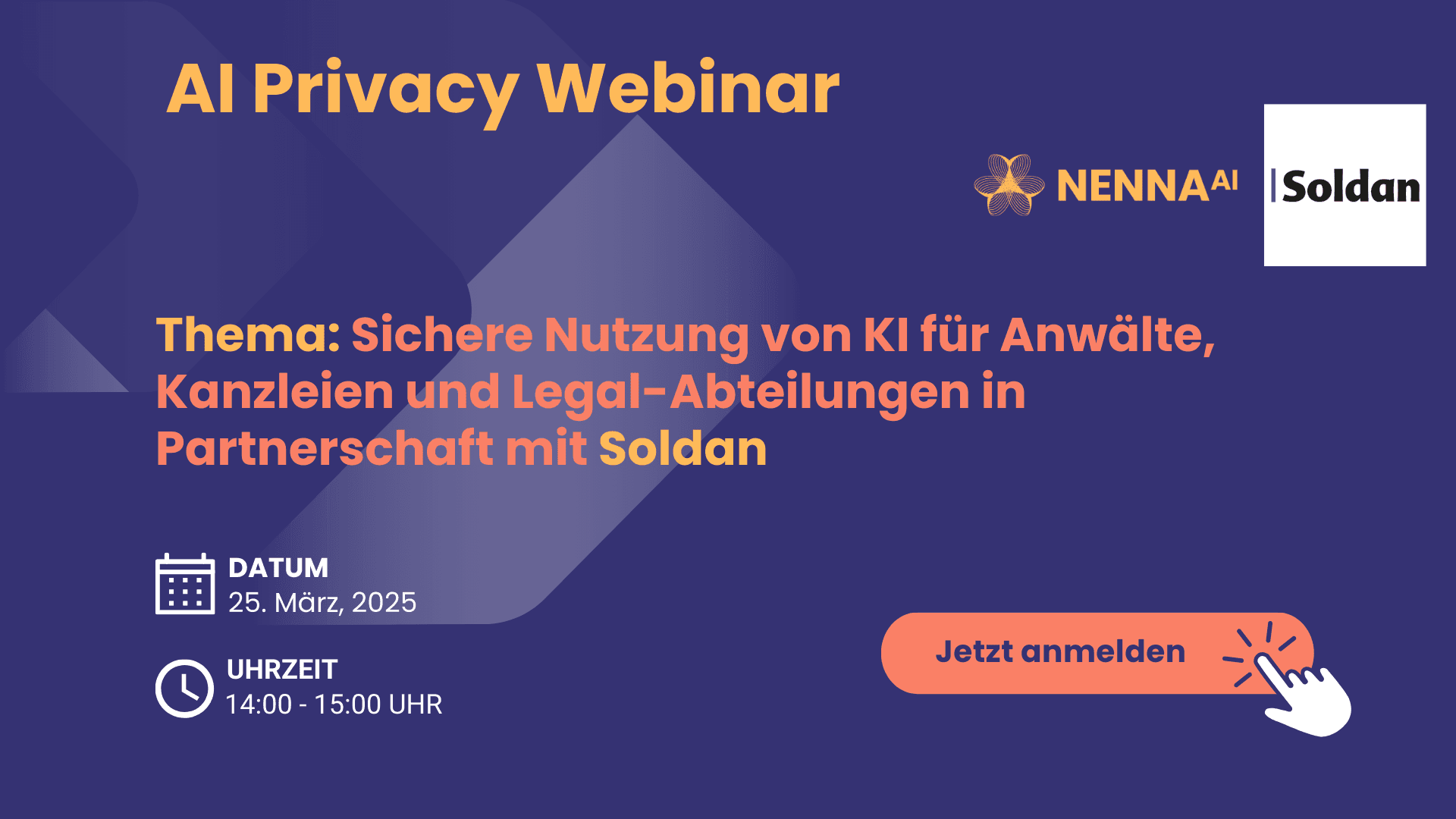
To learn more about the legal frameworks for using AI, check out our AI Privacy Webinar - Secure Use of AI for Lawyers, Law Firms and Legal Departments on 25.03.2025.
How does NENNA.AI help with the use of generative AI?
NENNA.AI is used via the browser and functions as a protective shield that masks personal data such as names, addresses, phone numbers and banking information before it is passed on to generative AI models. In principle, it works like antivirus software. This works with both prompts and files. Contracts and client briefings can therefore be used securely in the browser with AI models in compliance with data protection laws.
Law firms can use NENNA.AI to securely analyze confidential client documents, while financial service providers can conduct AI-assisted client analyses. In this way, NENNA.AI opens up the opportunity for companies across a wide range of industries to harness the efficiency of AI solutions in a controlled manner.
NENNA.AI gives company-wide control over AI use and enables an AI governance strategy through the Guardrails module. This means company-wide administrators can decide which AI applications are permitted and which are not. The platform of NENNA.AI also supports documents such as PDF and Word files, which can be uploaded to LLMs and masked.
Using NENNA.AI is highly efficient: users can unmask the data directly in NENNA and transfer it back into documents to be processed, such as emails, Word files or contracts. This allows tasks like translations, correspondence or personal contract queries to be handled securely and efficiently. As a result, companies benefit from rapid text processing and a real competitive edge because AI is utilized to its full potential.
If you have questions about NENNA.AI, would like a demo or need our advice on AI usage within your business, please feel free to contact us!
Read more
All items


